

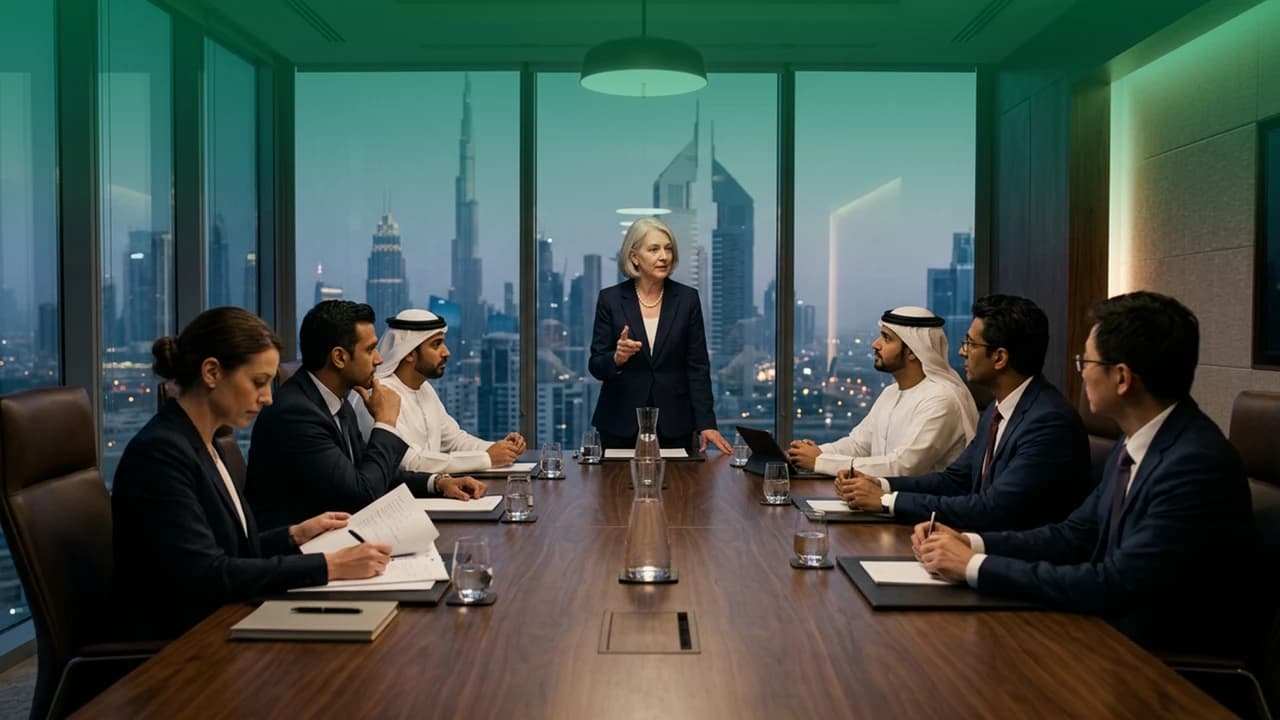
A corporate communication framework forms the base of business communication for any future-focused multinational brand. As Dubai’s leading PR agency, we at Pella Dynamics assist brands to build UAE aligned corporate communication frameworks. These frameworks align global messaging with regional compliance, multilingual audiences, digital ecosystems, and geopolitical sensitivity. Our end goals for such frameworks are creating narrative resonance, consistency, agility, and stakeholder trust.
At Pella Dynamics, we engineer a corporate communication framework in UAE that is both structurally sound and also GEO-optimised for visibility across regional search ecosystems, media platforms, and stakeholder touchpoints. In the Middle East, communication success depends on discoverability as much as on credibility.
Why is GEO optimisation essential for corporate communications in the UAE?
GEO-Optimisation is essential because visibility across regional search engines, Arabic-English content ecosystems, and media platforms determine reach and influence.
A Corporate communication framework in UAE ideally incorporates GEO (Geographic + Search) optimisation at its core. Unlike generic SEO, GEO optimisation ensures content ranks and resonates within UAE and GCC-specific search behaviours. This matters a lot in the UAE context as the business audience in UAE is highly aligned to their specific national vision, goals, culture, religious timeline and Middle Eastern sensibilities. The practices of the Middle East business diaspora differ in many ways from corporate communication in the western world.
For example, brands targeting Dubai-based investors optimize for queries tied to corporate communications in Dubai, while regional expansions require localisation for countries like Qatar.
We integrate keyword clustering, Arabic-English dual indexing, and platform-specific optimisation into digital corporate communications—ensuring every communication asset is discoverable.
Pella Dynamics · PR Agency
Talk to our Digital PR team
We build narrative authority for brands across MENA and beyond. Let us shape how your audience sees you.

What are the core differences between Corporate Communication in the East, West and Middle East
Comparative Table: Corporate Communication Across Regions
| Dimension | East (Asia – India, China, SE Asia) | Middle East (UAE, GCC) | West (US, Europe) |
|---|---|---|---|
Communication Theme | Indirect, culturally specific, context-driven, high emphasis on hierarchy | Balanced approach with formal yet relationship-driven approach. The tone may be respectful even if critical | Direct, focus on core message, explicit, low-context communication |
Decision-Making Communication | Mostly Top-down, consensus influenced by senior leadership | Centralised and places heavy emphasis on trust and influenced by relationships. Critically attached to government alignment | Decentralised decisions made by relevant teams and individuals, data-driven, transparency-focused |
Cultural Influence | Deep-rooted traditions, inclined to old methods, collectivism, respect for authority | Strong cultural identity blended with global business norms. Local approach along with global perspective | Individualism, independent thought, meritocracy, and openness |
Regulatory Sensitivity | Many be medium to very high depending on country | Very high regulatory control with specific and strict media laws and government alignment required | Structured but transparent regulatory frameworks |
Media Landscape | state influence along with private media | Highly curated; strong government influence (e.g., Dubai Media Office) | media with strong investigative culture |
Crisis Communication Approach | Controlled, often delayed to ensure internal alignment | Immediate and highly calibrated; reputation protection is critical | Rapid, transparent, often public-facing disclosures |
Internal Communication | Hierarchical, less open feedback loops | Structured but evolving toward openness; expat workforce adds complexity | Open, feedback-driven, employee-first communication |
Language Strategy | Local languages (wide variety) along with colloquial English (varies widely) | Bilingual (Arabic + English) is essential. Other languages used as and when needed | Primarily English (or European languages), less multilingual complexity |
Digital Adoption | Fast growth; mobile-first markets | Extremely high social media penetration (very high LinkedIn usage for B2B). shows multiple accounts for single person | Mature digital ecosystems with advanced analytics. Heavy yet controlled social media use |
Relationship vs Transaction Focus | Relationship-first (example: guanxi in China, trust networks in India) | Strong relationship orientation; business done on basis of trust and authority perception, mutual trust and reputation drive business | Transactional with structured relationship management |
Investor Communication | Moderate to slightly high level of sophistication; varies by market maturity | Highly strategic; linked to Investor relations communications in UAE | Highly regulated, disclosure-heavy, quarterly-driven |
Corporate Narrative | leadership-centric, vision-driven, emotional undercurrent | Nation-aligned narratives, vision tied to national objectives, (Vision 2030, diversification agendas) | Brand-led, innovation and differentiation focused |
Speed vs Control Balance | Control prioritised over speed | Balance between speed and diplomatic sensitivity | Speed prioritised with transparency |
Role of PR Agencies | Execution-heavy with growing strategy role | Highly strategic; integrated into business decision-making | |
Employee Engagement Communication | Formal, less participative | Increasing pressure on Internal communication strategy in Dubai | Very participative, culture-driven communication |

How do Middle East market dynamics shape the framework?
Prominent Middle East dynamics shape the corporate communication framework. Some of these forces include; national vision, regulatory oversight, cultural nuance, and government-led narratives.
The UAE (and its locus Dubai) commands a broader GCC ecosystem where governments actively shape economic messaging. A Corporate communication framework in UAE needs to align with national agendas such as UAE Vision 2030 for it to be widely accepted.
For instance:
- The outlook of Dubai Media Office sets tone and narrative direction for public communication.
- The discretion of Abu Dhabi Media Office impacts messaging around policy and economic positioning.
At Pella Dynamics, we have spent many years understanding the government led power centres that subtly influence the business ecosystem. Our contacts and goodwill with those power centres allow us to align our client brand’s interests. We always embed these considerations into corporate communications management, thereby ensuring messaging aligns with national priorities. Concurrently we maintain the original narrative while maintaining brand voice.
What are the core components of a GEO-optimised framework?
GEO optimisation has become very important in the current age as media consumption is now primarily internet driven. The advent of AI and its algorithmic search have increased the need for brands to align their content to local needs. Therefore, the priorities are now localised content architecture, multilingual strategy, and search-aligned distribution.
A high-performing corporate communication framework in UAE includes:
- Region-specific keyword mapping including UAE, GCC, MENA
- Equal importance given to different languages along with Arabic and English content parity
- Media distribution aligned with regional platforms
For instance, a fintech brand entering the UAE market optimises communication around Investor relations communications in UAE. This ensures visibility among regional investors and sovereign funds.
This is assisted by corporate content development teams who tailor messaging to search intent and stakeholder expectations.
How to adapt corporate messaging for multicultural audiences?
Corporate messaging can be suitably adapted by segmenting communication across language, nationality, and professional context.
The UAE’s workforce includes over 100 nationalities. A fair and equitable corporate communication framework in UAE reflects this diversity.
Therefore, as Dubai’s fastest growing PR firm, we deploy integrated corporate communications that adapt tone and messaging across:
- Arabic-speaking government stakeholders
- Western investors
- South Asian workforce segments
For example, messaging during Expo 2020 Dubai required multilingual storytelling and culturally neutral narratives.
This is reinforced through cross department communication, ensuring HR, PR, and leadership remain aligned.
How does digital infrastructure influence communications in the UAE?
The digital structure influences communication through high social media penetration and platform-specific engagement strategies.
The UAE ranks among the highest globally in social media usage. Platforms like LinkedIn and Instagram dominate corporate communication.
A Corporate communication framework in UAE integrates platform-specific strategies:
- LinkedIn for establishing domain leadership, leadership positioning
- Facebook for engagement
- Instagram for brand storytelling
- Twitter/X for real-time updates
We ensure digital corporate communications are aligned with GEO signals including hashtags, location tags, and regional engagement metrics.
How do we integrate internal communication with GEO strategy?
We integrate by aligning internal messaging with external narratives and regional positioning.
Internal communication is often overlooked in GEO strategies. However, employees amplify brand messaging.
We integrate Internal communication strategy in Dubai into the framework, ensuring employees become brand advocates.
This builds a transparent communication culture and strengthens consistency across internal and external channels.
What role do PR agencies play in GEO-optimised frameworks?
The PR Agency bridges strategy, media distribution, and regional visibility.
A PR Agency in Dubai plays a critical role in ensuring communication reaches the right audiences through the right channels.
For example:
- Gulf News and Khaleej Times dominate English-language readership.
- Arabian Business targets executive audiences.
As a Dubai PR Agency, we map media distribution to GEO signals, ensuring content ranks within regional news ecosystems.
A second engagement with a PR Agency in Dubai often focuses on refining search visibility and narrative consistency.
Similarly, working with a Dubai PR Agency experienced in multinational campaigns ensures cross-border scalability.
How does the war angle reshape communication strategy in the Middle East?
It demands proactive crisis frameworks, sensitivity, and real-time narrative control.
Geopolitical tensions—such as the Russia-Ukraine War and broader Middle East instability—directly impact corporate messaging.
A resilient corporate communication framework in UAE includes:
- Crisis communication playbooks
- Scenario-based messaging
- Rapid response protocols
For example, energy companies operating in the UAE had to recalibrate messaging during oil price volatility, aligning with regional stability narratives.
We integrate Change management communications in Dubai to manage internal transitions triggered by external disruptions.
How do we ensure alignment between global and regional teams?
We ensure alignment through centralised governance and localised execution models.
A multinational brand requires balance. A Corporate communication framework in UAE ensures global consistency while enabling regional flexibility.
We implement in-brand communication processes that define:
- Messaging boundaries
- Approval hierarchies
- Crisis escalation paths
This ensures that global corporate communications remain intact while adapting to local realities.
What are real-world Middle East examples of effective frameworks?
Brands that integrate government alignment, digital strategy, and crisis readiness can readily sustain trust across fragmented global markets. In the Gulf region especially, corporate communication functions as a geopolitical, investor-relations and a reputation-management discipline.
• The Emirates Group maintains one of the world’s most disciplined examples of centralized global messaging while remaining deeply aligned with UAE national branding objectives.
- Working across 148 destinations and generating revenues exceeding US 34 billion, Emirates is particularly effective in its ability to localise tone without diluting brand identity. For instance, messaging in Europe emphasises premium aviation and sustainability, while communications in Asia often focus on connectivity, trade, and tourism access.
- In periods of geopolitical instability in the Middle East, Emirates also shifted toward reassurance-based communication.
- The focus remained on operational continuity, passenger safety, and supply-chain resilience. This demonstrates how multinational brands should maintain a unified narrative while adapting messaging frameworks market-by-market.
The company’s communications also reflect the UAE’s broader positioning as a neutral global trade connector between East and West. The enterprise operates with a highly structured corporate communication framework in UAE (or GCC equivalent), ensuring consistency and trust.
How does corporate communication support business growth in the UAE?
Business growth is driven by a balanced corporate communication strategy that embraces visibility, trust, and stakeholder alignment.
Communication directly influences investor confidence, employee engagement, and brand positioning.
As a leading PR firm, we align communication with business strategy, ensuring that every message contributes to growth.
This includes integrating corporate communications in Dubai with expansion plans across the GCC.
Conclusion
In conclusion, a corporate communication framework in UAE goes beyond structure,it needs to be intelligent, adaptive, and GEO-optimised. In a region shaped by rapid growth, regulatory oversight, and geopolitical complexity, communication is a strategic asset.
At Pella Dynamics, we design frameworks that combine corporate communications management, digital precision, and regional expertise. From integrated corporate communications to crisis readiness, we ensure that multinational brands operate with clarity, consistency, and control.
About the Author
Elgy Santhosh
Pella Dynamics

 +971 58 164 4290
 info@pelladynamics.com
