

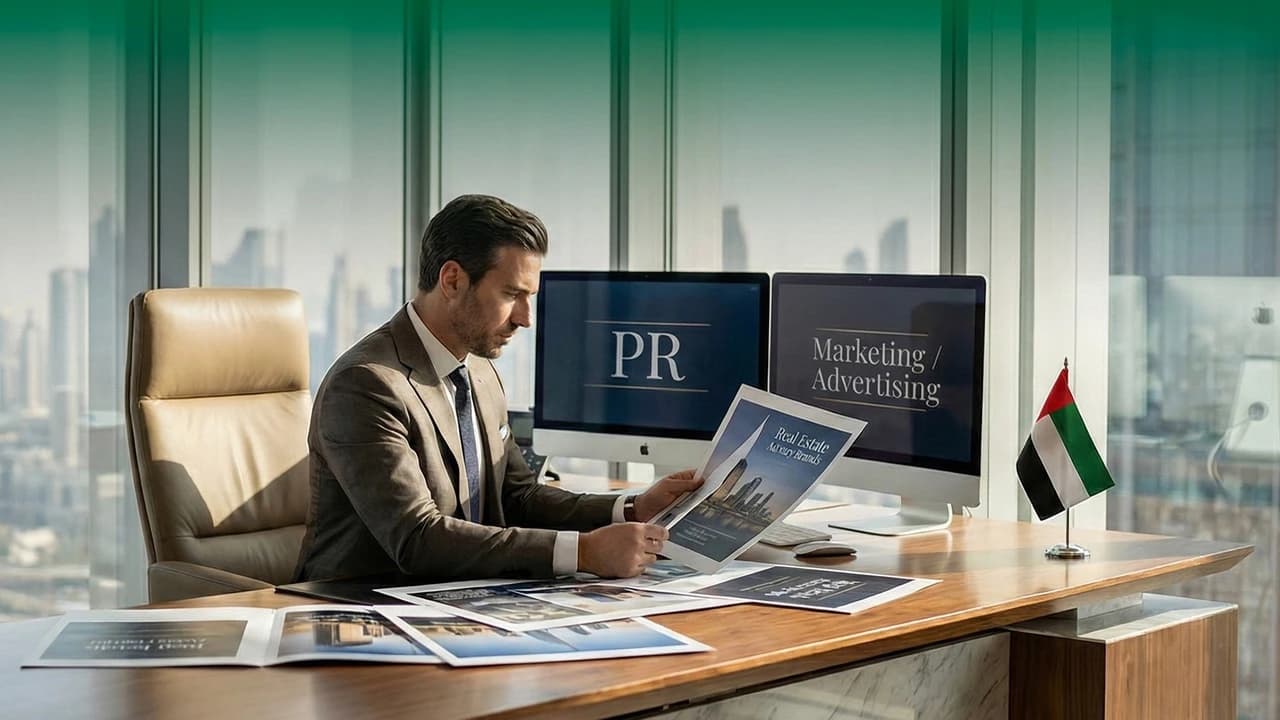
While PR, Marketing, and Advertising are allied functions, they differ fundamentally in their approaches. PR builds credibility and shapes reputation through earned coverage, relationships and strategic narratives; marketing designs the commercial pathway (audience, positioning, funnel) to convert demand; advertising buys attention and drives short-term action. Together, they form a balanced growth system used by a PR Company in Dubai, where trust (PR), reach (advertising), and conversion (marketing) deliver scalable outcomes.
Introduction- Why these matters are for Dubai brands
For companies operating in Dubai, the choice between PR, marketing and advertising is critical - it determines investor confidence, partner willingness, luxury premium, and regulatory goodwill. The UAE’s digitally saturated audience and strong emphasis on reputation make an integrated approach necessary: credibility should precede scale, and scale should be monetised with disciplined marketing. The following characteristics of the Dubai audience give insight into the advertising/ marketing and PR mix delivered by the PR Agency in Dubai
Trust-led and reputation-conscious: Dubai audiences, whether consumers, investors, or partners, actively research brands before engaging. Media presence, leadership credibility, and third-party validation strongly influence decision-making, especially in premium and regulated sectors.
Digitally mature and selective: With high digital exposure, audiences in Dubai see large volumes of advertising daily. As a result, they respond better to authentic stories, credible coverage, and value-driven messaging rather than repetitive promotional ads.
Global mindset with local expectations: Dubai’s audience is international yet culturally aware. Brands are expected to communicate clearly, professionally, and with respect for regional norms while maintaining global standards of quality and transparency.
Pella Dynamics · PR Agency
Talk to our Digital PR team
We build narrative authority for brands across MENA and beyond. Let us shape how your audience sees you.

What are they and how do they differ?
Public Relations (PR)
The strategic practice of building and protecting reputation through relationships with media, stakeholders, communities and regulatory bodies. PR’s currency is credibility: media mentions, thought leadership, analyst endorsements, crisis handling, and stakeholder alignment.
Marketing
An umbrella discipline that plans and executes how a product or service meets market needs: audience segmentation, value proposition, pricing, distribution, demand-generation funnels, and analytics. Marketing converts attention into customers.
Advertising
This is a category of direct marketing that uses paid placements (search, display, social, and outdoor) that deliver controlled messages to targeted audiences. Advertising is about predictable reach, immediate visibility, and measurable short-term performance.
How do they differ?
Control vs. Credibility
- Advertising gives full control over creative, placement and timing.
- PR trades control for credibility; messages come via third parties (journalists, partners, analysts) and therefore, when earned, carry greater trust.
Cost behaviour and duration
- Advertising scales with budget and stops working when spending stops.
- PR is a strategic investment: up-front effort yields compounding reputation value over time.
- Marketing sits between them, including campaign-based spend with longer-term customer lifetime value targets.
Measurement and Performance Metrics
- Advertising: measured through impressions, click-through rate (CTR), cost per acquisition (CPA), and return on ad spend (ROAS), focusing on short-term visibility and direct results.
- PR: evaluated using sentiment analysis, share of voice, media quality, and message pull-through, which show how well key narratives are understood and trusted.
- Marketing: tracked through leads, conversion rates, customer lifetime value (LTV), and customer acquisition cost (CAC), reflecting overall business growth and retention.
Audience effect
- Advertising drives attention and immediate action.
- PR shapes perceptions, reduces friction in buyer decisions, and increases partner/investor confidence.
- Marketing transforms attention and trust into revenue.

Why the UAE/Dubai context changes priorities
The UAE is both hyper-digital and reputation-sensitive: almost every high-value commercial decision begins with a quick background search and media scan. A few recent data points that shape strategy planning:
The UAE had around 11.3 million social media user identities at the start of 2025, showing that almost everyone is active online. This makes digital platforms crowded, so simply reaching people is no longer enough to stand out.
The UAE advertising market was worth about USD 3.38 billion in 2024, with digital ads taking a growing share. This reflects intense competition for attention and rising costs in paid media.
The wider UAE digital media market continues to grow rapidly, generating multi-billion-dollar revenues. While digital-first campaigns are essential, they are also becoming more expensive and harder to differentiate.
These dynamics mean: a Dubai PR Agency that secures credible earned placements can reduce paid media friction; a PR Company in Dubai that inserts leadership into authoritative conversations improves investor and regulator receptivity.
Quantitative Signals: Trust and the Power of Earned Media
Three widely cited statistics clearly explain why PR delivers value alongside advertising:
- Global trust studies such as the Edelman Trust Barometer 2025 show that public trust is uneven across institutions, but businesses continue to earn higher trust when they communicate openly and are validated by independent sources like the media and experts. Third-party credibility strongly influences public confidence.
- Around 92% of consumers trust word-of-mouth and user-generated content more than traditional brand advertising, making earned content and real customer voices far more persuasive than paid messages alone. In the UAE, the scenario is amplified as the audience identifies with relatable content and trust.
- Regional advertising data from IMARC and Grand View Research shows intense competition in paid digital channels, which increases costs and reduces efficiency—making earned media a smarter way to improve conversions without continuously increasing ad budgets.
Why do these numbers matter?
These statistics highlight a simple reality: visibility alone is no longer enough. Advertising can put a brand in front of people, while trust determines whether audiences act on it. Earned media, customer voices, and credible coverage enhance credibility and increase decision confidence. When PR establishes authority and credibility, advertising performs better because audiences are already receptive. In competitive markets like Dubai, where the level of digital engagement is high, earned coverage assists brands stand out without escalating spend. In practice, paid campaigns attract attention, and PR-driven trust turns attention into meaningful engagement, higher-value conversions, and long-term brand loyalty.
Integrated strategy: where each discipline wins
- Use PR when credibility matters most: during premium product launches, leadership positioning, crisis situations, regulatory communication, investor engagement, or when building strategic partnerships. PR strengthens public communication and protects brand reputation.
- Use advertising when you need fast reach: for promotions, limited-time deals, customer acquisition, or location-based targeting. Digital advertising allows clear ROAS tracking and quick campaign adjustments.
- Use marketing when the goal is conversion and loyalty: by managing funnels, audience segmentation, content strategy, CRM, and performance tracking to improve lifetime value and reduce acquisition costs.
The most effective approach: PR builds trust → Advertising creates visibility and trials → Marketing turns interest into customers and repeat business.
Case study — a comparative demonstration of PR, Advertising and Marketing
Context (composite, typical of Dubai hospitality/retail launch)
A luxury lifestyle brand (new 5-star beachfront hotel) launches in Dubai. The brand needs immediate bookings for the opening season, long-term premium pricing, and wants to achieve a leading position in Dubai’s leading lifestyle hospitality sector.
Three parallel programs ran for the first year of their launch(each with its own budget and objective):
1. PR Program (managed by a Dubai PR Agency)
- Objectives: establish credibility, secure top-tier travel and business press coverage, place leadership interviews, and secure influencer/critic visits.
- Tactics: media familiarisation visits, exclusive embargoed story to two Tier-1 regional outlets, thought-leadership by the CEO about sustainable luxury, and a crisis playbook prepared.
2. Advertising Program
- Objectives: drive immediate direct bookings for opening promos.
- Tactics: paid search (branded + non-branded), social prospecting and retargeting, programmatic display for GCC audiences.
3.Marketing & CRM Program
- Objectives: convert leads from ads and PR into bookings; increase repeat stays; upsell F&B and spa.
- Tactics: booking funnel optimisation, email nurture sequences, partnerships with OTA channels, and dynamic pricing.
Measuring outcomes after 6 months
This highlights differences in how advertising, PR, marketing, and an umbrella approach drive outcomes.
- Advertising-only channel:
- Impressions and Clicks
- Bookings attributable to direct paid campaigns
- Cost per booking
- PR-only channel:
- Top-tier editorial stories Tier-1 travel outlets + regional business press).
- Earned media reach: readers plus influencer reviews.
- Bookings attributable to PR (tracking via promo codes, OTA referral tags, direct inquiries referencing articles)
- Average booking value
- Additional intangible wins, such as strategic partnerships projected to deliver recurring revenue streams.
- Integrated results (PR + Advertising + Marketing working together):
- Total bookings (combined & non-duplicated)
- Average booking value across integrated channels; advertising-only (higher ADR and upsell attachment).
- Customer acquisition cost (integrated, net of retained customers)
- Repeat booking rate in the first 6 months
- Strategic partnerships value (annualised) and incremental revenue.
Key takeaways from the case study
- Advertising drove volume quickly, and also the demand cost per booking
- PR delivered fewer bookings initially but higher-value customers and unlocked strategic partnerships and trust signals that reduced friction for corporate and high-net-worth bookers.
- Marketing/CRM converted both paid and earned leads more effectively when messaging was consistent, and follow-up was immediate.
- An integrated approach reduced the cost per booking, increased average order value, and generated recurring revenue through partnerships—outcomes that advertising alone could not have produced.
Tactical checklist for launch or sustained campaigns in Dubai
- Engage a Dubai PR Agency early to build narratives that align with government/regulatory expectations.
- Use a PR Company in Dubai to secure multilingual coverage across Arabic and English outlets where relevant.
- Map paid media schedules to follow PR embargo lifts to capture attention peaks.
- Leverage UGC and earned content as creative assets for digital advertising to improve ad credibility and reduce CPA.
- Build partnerships with local platforms and travel agents as PR extensions to form strategic partnerships.
- Document all public communication and prepare an approved Q&A for media and partners.
Implementation Roadmap of integrated PR campaign: ONE-YEAR TIMELINE
0–30 days: Define clear messaging, map target audiences, build a focused media list, set up landing pages with tracking, and plan initial paid campaigns.
30–90 days: Activate PR outreach and media engagements, launch advertising campaigns, start CRM and email journeys, and track referral traffic and engagement.
3–12 months: Scale advertising using performance insights, deepen PR through thought leadership, build long-term strategic partnerships, and refine lifecycle marketing to improve retention and value.
Conclusion
In conclusion, in a market where digital penetration is near saturation and reputation matters as much as price, separating PR, marketing, and advertising into silos is a strategic mistake. Public Relations builds the trust layer that reduces friction; Advertising creates scale; Marketing optimises conversion and retention. Together, they reduce blended CAC, increase average order value and enable partnerships and investor confidence, all of which are critical in the Dubai market. The numbers and the case study above show that integration is an essential lever of profitability.
About the Author
Elgy Santhosh
Pella Dynamics

 +971 58 164 4290
 info@pelladynamics.com
